
In this blogpost Ilenia Petrarulo explains to us her really interesting work presented at the 53rd CAA International Conference, hosted by the University of Vienna from 31 March to 4 April 2026 (CAA stands for Computer Applications and Quantitative Methods in Archaeology).

Author: Ilenia Petrarulo
Ilenia is a Doctoral Researcher at the IHIST. She works on the project “Climate and Environmental Events in Antiquity and Early Middle Ages: a Contribution to the Archeology of Climate Change” under the supervision of Andrea Binsfeld.
At the end of March, I travelled to Vienna to present my PhD research at the 53rd CAA International Conference, hosted by the University of Vienna from 31 March to 4 April 2026. CAA stands for Computer Applications and Quantitative Methods in Archaeology, an association that brings together not only archaeologists but computer scientists, geographers, historians, data scientists, and digital humanists, all united by the conviction that computational methods have something essential to offer to the study of the past. Walking through the sessions, you could find, for example, presentations on machine learning, 3D documentation, AI-assisted heritage reconstruction, spatial modelling of past landscapes and human ecosystems, linked open data, chronological modelling, agent-based demographic simulations. The theme this year was It’s all about people, to emphasize a shared conviction that behind every dataset, every model, and every algorithm, there are human decisions, human communities, and human histories that give the work its meaning.
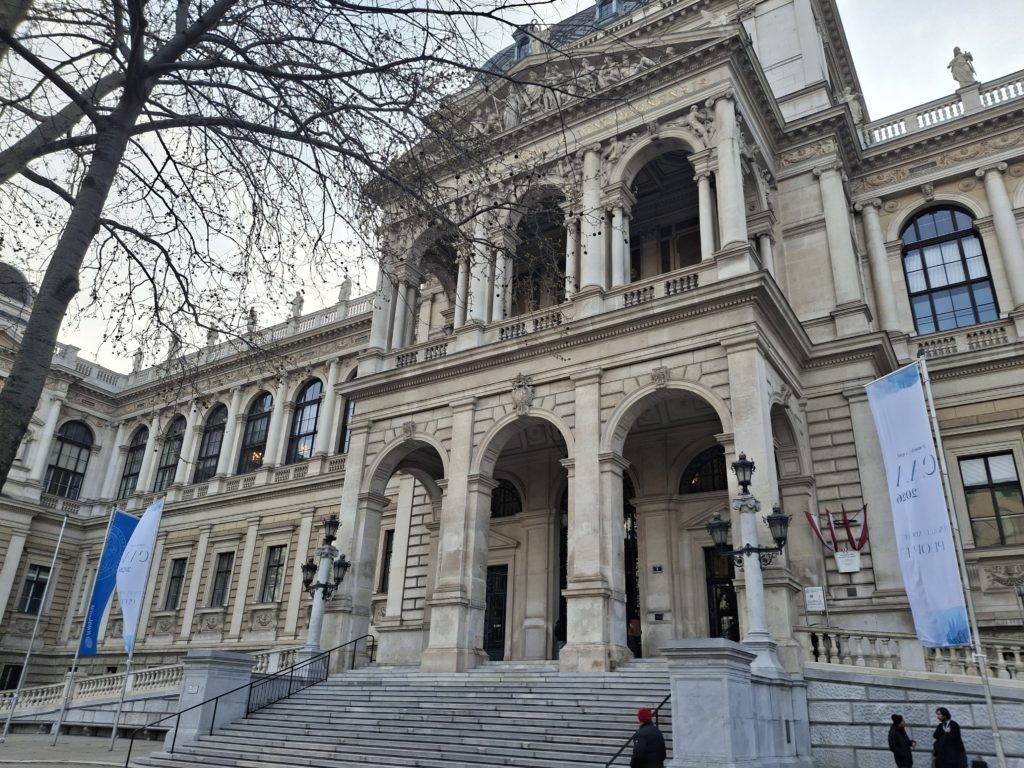
It was not my first time in Vienna, but the visit reminded me how much this city can fill you with wonder. The venue itself, the University of Vienna, founded in 1365, occupies a grand building on the Ringstraße, erected in the late nineteenth century. Moving between sessions through its corridors and ceremonial halls, it was hard not to think about the layers of history written into the building. The Great Hall (Grosser Festsaal), with their soaring ceilings, was the very space for which Gustav Klimt was commissioned to paint his Faculty Paintings in 1894, works that caused one of the most spectacular art scandals of early twentieth-century Vienna before being destroyed in 1945. Captured only in black-and-white photographs, they seemed lost forever. Almost. In a remarkable recent project, artificial intelligence was used to reconstruct the paintings in full colour, combining machine learning on thousands of artworks with detailed contemporary art criticism. That this happened just steps away from where we were presenting our own computational research felt like more than a coincidence: it was a reminder of how much computational methods can offer to cultural heritage.
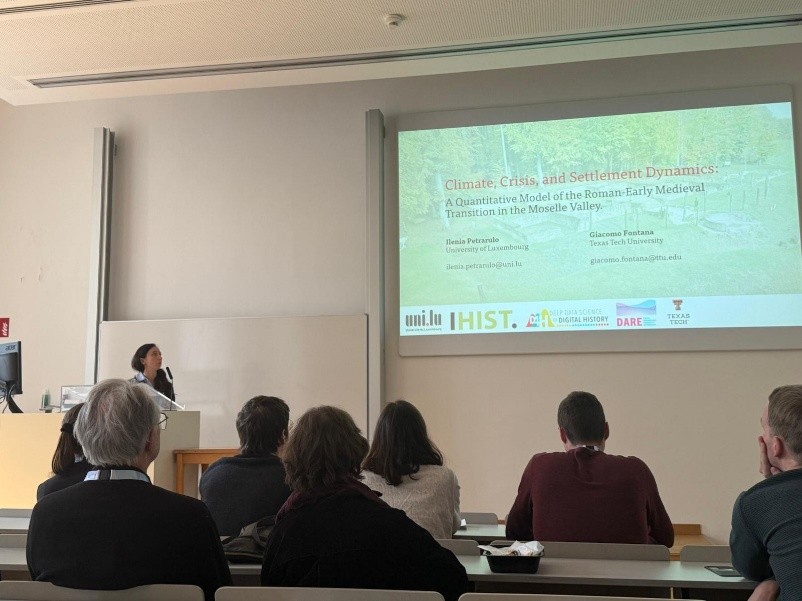
I also participated in two pre-conference workshops on 31 March at TU Wien: one on chronological modelling with ChronoLog, a tool for building and testing chronological models and computing chronological estimates; and one on archeoViz, an open-source platform for the visualisation, statistical exploration, and web diffusion of archaeological spatial data. Both sessions were hands-on and methodologically focused, a useful counterpoint to the broader conference discussions that followed. Within the session “Bridging Micro and Macro Perspectives in the Modelling of Past Human Ecosystems”, I presented part of my PhD thesis, entitled “Climate, Crisis, and Settlement Dynamics: A Quantitative Model of the Roman–Early Medieval Transition in the Moselle Valley”. The results shown were developed in collaboration with Dr. Giacomo Fontana from the DARE Lab at Texas Tech University, where I spent a period as a visiting PhD researcher in 2025. The feedback I received was direct and constructive, and gave me a clearer sense of the methodological challenges that need to be addressed before the thesis defence.
One of the most pleasant surprises of the day was finding myself presenting alongside Dr. Kaarel Sikk, a former PhD student of our same doctoral school at the University of Luxembourg, now researcher based at the University of Tartu. Discovering this unexpected connection was a reminder of how far the D4H network reaches.
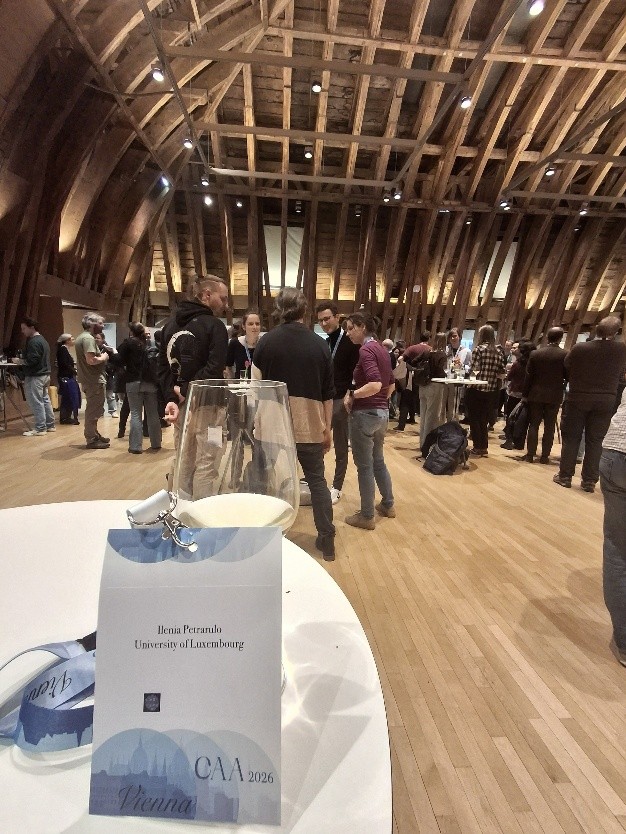
Beyond the sessions, the conference offered something harder to plan for: conversations. Between coffee breaks and ice-breaker events, over four days I met researchers from institutions all over the world, working on many different and incredibly interesting questions. The possibilities for future collaboration, opening up new research directions, feel more concrete now than before. That is, perhaps, the most honest argument for in-person conferences in an era when everything can be done remotely: the unplanned conversation in the corridor, the question after the session that turns into a longer exchange, the sense of a community that is genuinely working on the same problems from different angle.
I came back to Luxembourg with a longer reading list, a clearer sense of what my project needs, and a stronger conviction that this kind of work, ambitious, interdisciplinary, and methodologically demanding, is worth doing. See you next year at CAA in Santiago de Chile!