Throughout the 2026 Spring Semester we were lucky enough to have a variety of really thought-provoking talks done by the DTU doctoral and post-doctoral researchers. Please have a look at this post if you would like to know more!

Author: Elena Fernandez Fernandez
Elena is a postdoctoral researcher at C2DH and the academic coordinator at the DTU.
The DTU community holds monthly meetings were PhD students and Post-doctoral researchers are encouraged to share their work by giving talks (fifteen minutes) followed by a Questions-and-Answers session (fifteen minutes). We have been very lucky to have two volunteers per month that have very generously shared their very interesting research projects with all of us!
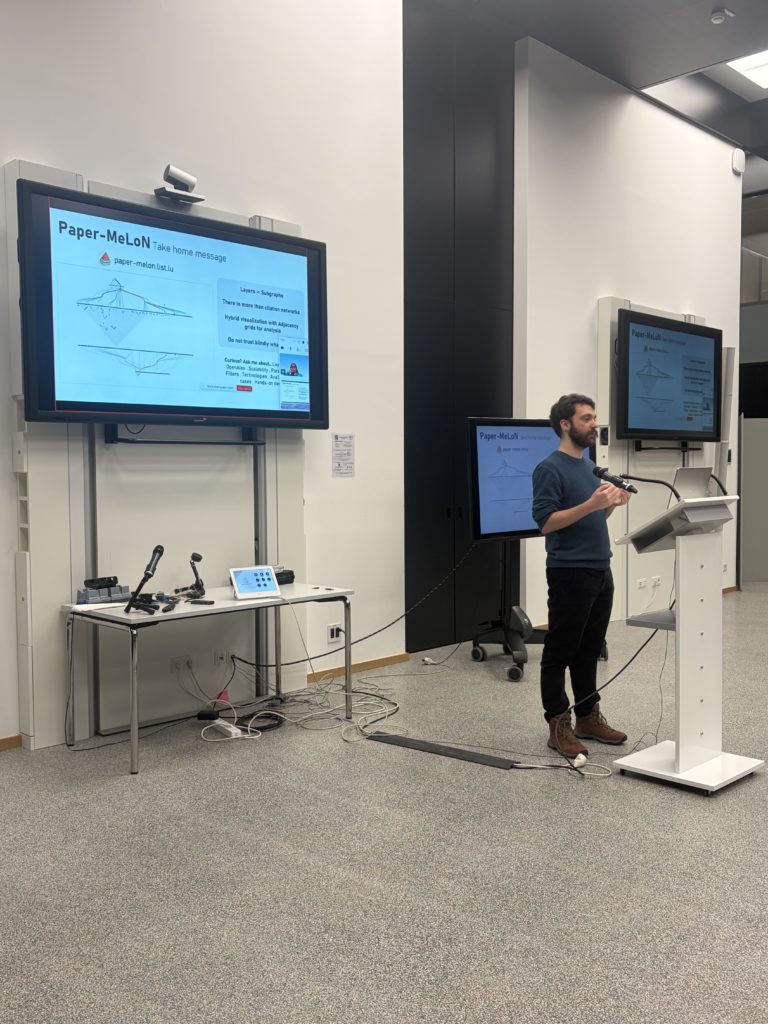
In April 2026 we had the pleasure of breaking the ice with very high-quality research talks done by Eloi Durant and Ferdaous Affan. Eloi Durant (Éloi Durant – Deep Data Science of Digital History) is a post-doctoral researcher in the Visualization and Interaction group at LIST, under the supervision of Mohammad GHONIEM. In his presentation, “Paper-MeLon: Literature review networks through the multi-layer lens ”, Eloi shared with us Paper-MeLoN, a web interface for exploring multilayer literature networks in which each layer represents a type of relationship between papers. He introduced a “review update” use case using previously published literature reviews and bibliographic data collected from OpenAlex.
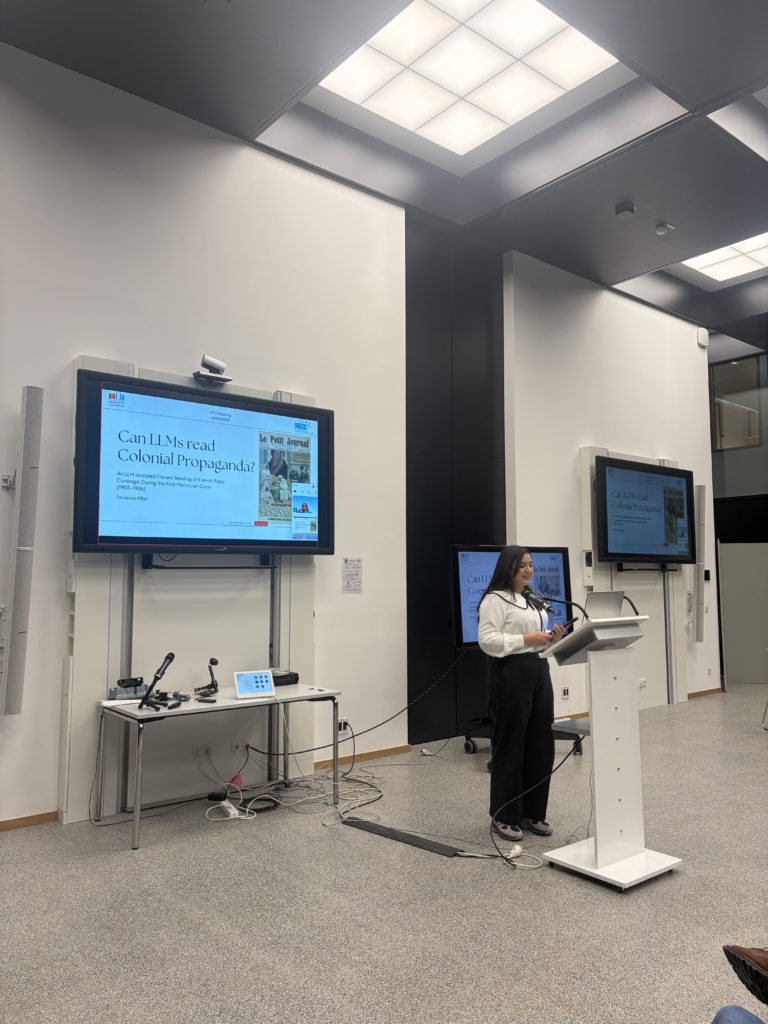
Ferdaous Affan (Ferdaous Affan – Deep Data Science of Digital History) is a PhD candidate at the C2DH working on the project ‘Media, Empire, and Propaganda: A Multilayer Analysis of Colonial Discourse and Power in Historical Newspapers during the Scramble for Africa (1880-1914)’ under the supervision of Marten Düring. In her talk, “Can LLMs read Colonial Propaganda? An LLM-Assisted Distant Reading of French Press Coverage During the First Moroccan Crisis (1905–1906)”, she presented a case study from her doctoral project, on French press coverage of the First Moroccan Crisis (1905–1906), where she proposed the Colonial Communication Analysis Framework (CCAF), a hierarchical taxonomy grounded in postcolonial theory and developed iteratively from close reading of primary sources.
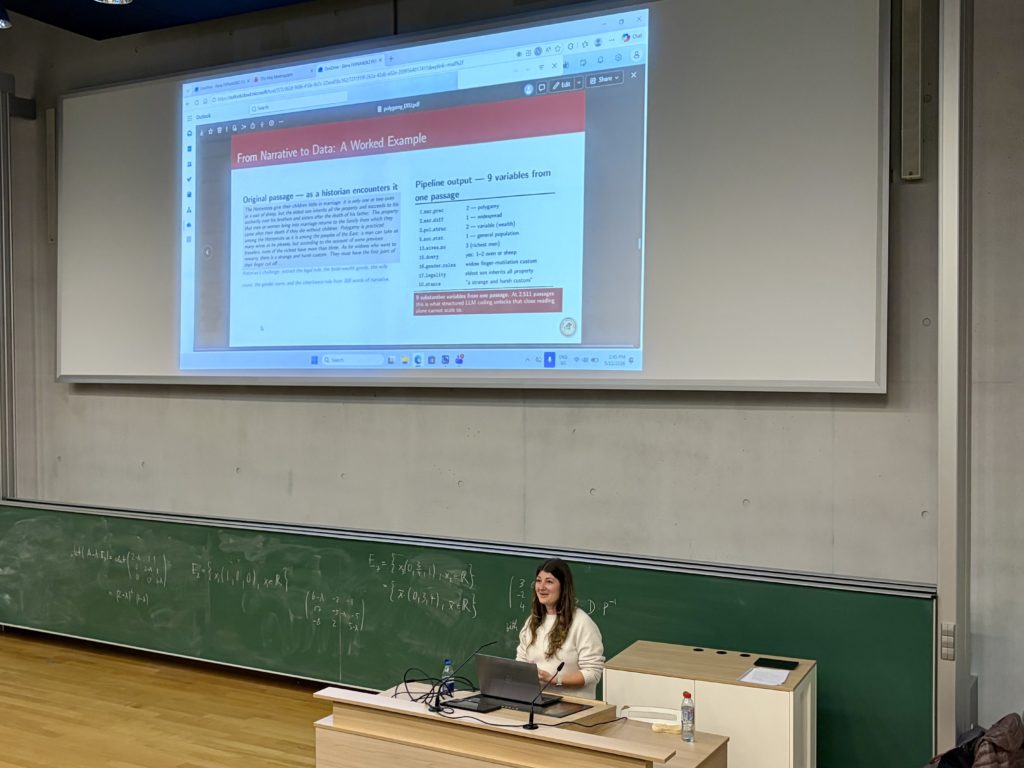
Then, in April 2026, we treated ourselves with two more really interesting talks done by Lauren Coetzee and Prince Yawn Gharbin. Lauren Coezee (Lauren Coetzee – Deep Data Science of Digital History) is a doctoral researcher at the C2DH working under the supervision of Sean Takats and Marten Düring. In her fascinating talk, “Beyond Murdock: Polygyny Across Time. European Travel Narratives and the dynamic history of African Marriage Systems”, she challenged traditional Western views on marriage and polygamy in pre-colonial Africa using the Time Traveler corpus — 2,994 European travel accounts spanning 1600 to 1900 — and applying an LLM-assisted classification pipeline to extract structured evidence from historical prose at scale. Across 2,511 classified passages, she found that polygamy was documented continent-wide rather than concentrated in West Africa.
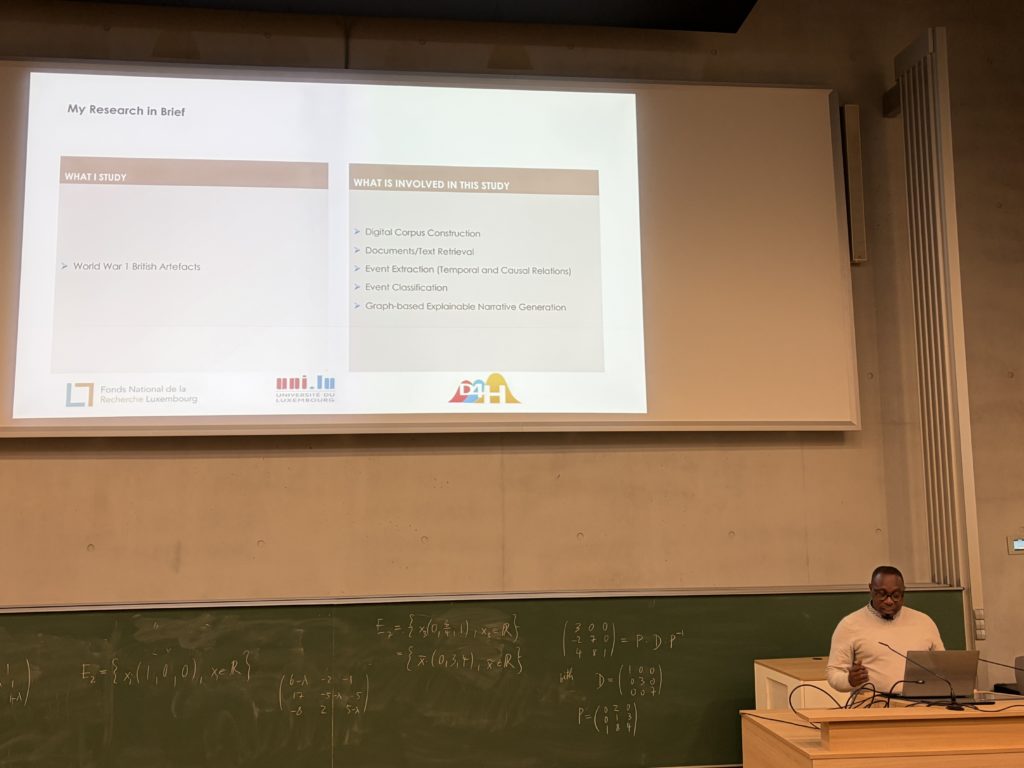
Prince Yaw Gharbin (Prince Yaw Gharbin – Deep Data Science of Digital History)is a doctoral researcher at the FSTM. He works on the project “Creating Historical Stories with Illustrations for Digital History using Natural Language Processing and Deep/Machine Learning Models” under the supervision of Christoph Schommer. In his talk, “Explainable Narrative Generation in Digital History Systems (World War I British Artefacts 1914 – 1918)“, Prince introduced a graph-based temporal-causal reasoning framework centered on a directed event graph constructed from World War I archival materials, including letters, diaries, reports, and other British artefacts. In Prince’s work, each event node represents a historical occurrence enriched with attributes such as actors, locations, temporal references, event types, document provenance, and linguistic triggers. Directed edges encode temporal and causal relationships, enabling the system to model both event sequences and inter-event dependencies. Through graph traversal and multi-hop reasoning, the framework identifies relevant event pathways, which are subsequently transformed into source-grounded historical narratives using Large Language Models.
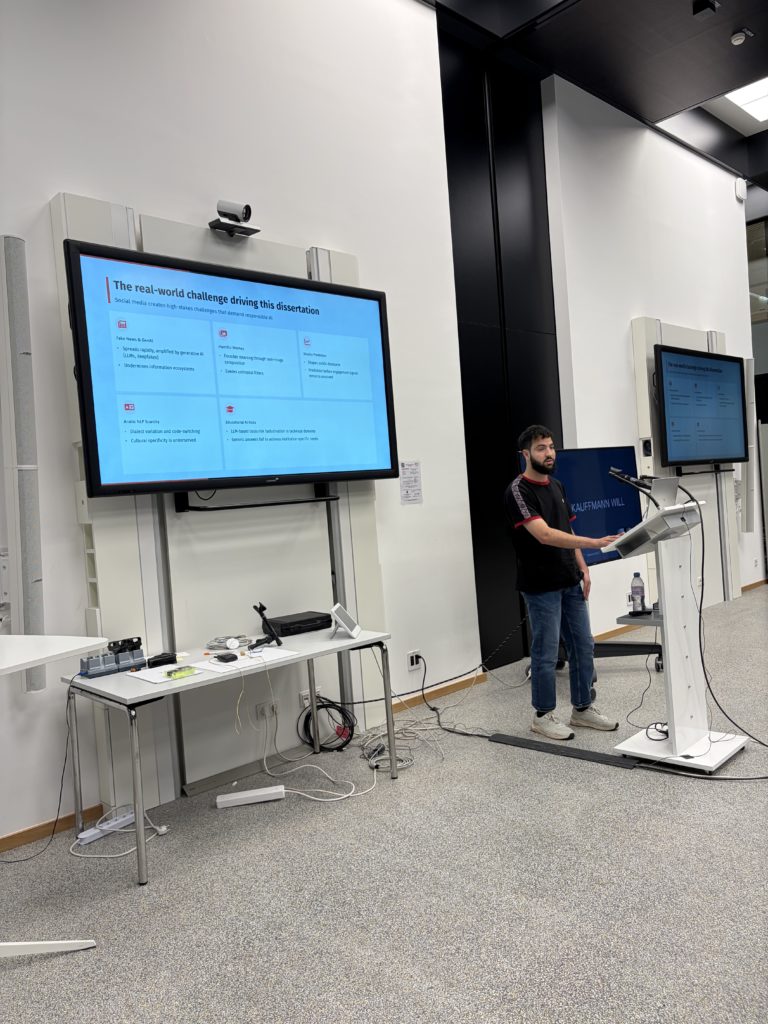
And finally, to wrap up a great semester, we had two fantastic speakers in June 2026: Samir El-Amrany and Titayna Kauffmann Will. Samir El-Amrany (Samir El-Amrany – Deep Data Science of Digital History) is a doctoral researcher at the FSTM working on the project “Detection of Fake News with Multimodal Data Analytics” under the supervision of Pascal Bouvry. In his talk, Responsible Multimodal Language Technologies for Social Media Understanding and Educational AI, Samir explained to us the main three points of his DTU doctoral work so far: developing trustworthy multimodal language technologies across different domains such as fake news, harmful meme detection, virality prediction, Arabic commonsense reasoning, and institution-grounded tutoring. Across these settings, Samir explores how reliable Natural Language Processing (NLP) systems require multimodal grounding, language- and culture-specific evaluation, and system-level safeguards that make outputs verifiable.
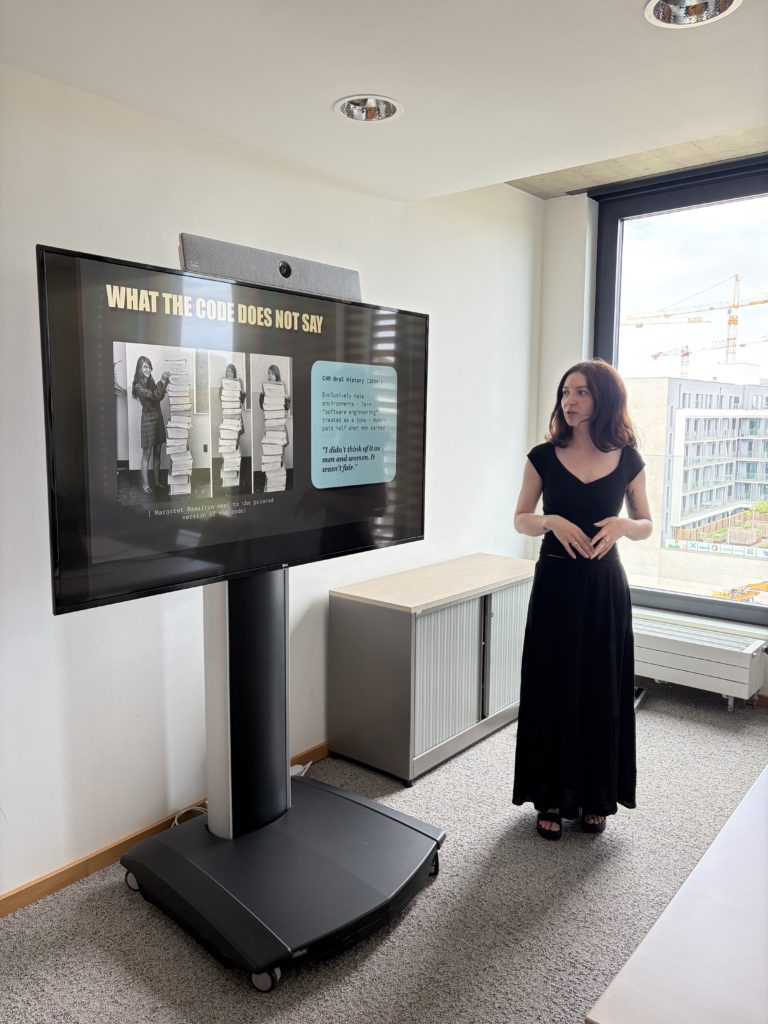
Titayna Kauffmann Will is a C2DH doctoral researcher. She works on the project “Code as Source” under the supervision of Valérie Schafer. In her talk, “Code as Heritage: Preserving and Interpreting Software as Historical Evidence“, Titayna introduced a lesson developed for the RANKE.2 platform that teaches historians to approach source code as both technical artifact and cultural expression, through three dimensions: the recognition of source code as born-digital heritage, the application of source criticism methods to code artifacts, and the institutional infrastructures through which software is being preserved today. She used case studies ranging from the Apollo Guidance Computer to the Microsoft BASIC lineage, and she explored the idea that reading code historically requires methodological adaptation. Finally, she made the very interesting link of understanding broader research on code as a primary historical source, and therefore, contributing a pedagogical dimension to theoretical arguments about what it means to treat software as evidence rather than infrastructure.
Thank you so much to all the speakers for their fantastic presentations and thanks very much to the whole DTU research community for posing very interesting questions that created a highly enriching intellectual atmosphere where ideas and suggestions were exchanged. And of course: please stay tuned for more great talks in Fall 2026!