

Author: Lauren Coetzee
Lauren Coetzee is a PhD candidate at the Centre for Contemporary and Digital History (C²DH), University of Luxembourg. Her dissertation examines economic and social institutions in pre-colonial Africa, 1500–1900, with a particular interest in pre-colonial African commodity currency systems. She is also Research Manager and GIS Consultant for the Time Traveller Project.
A centenary roundtable and a day pulling apart Murdock’s Ethnographic Atlas walked into the same conclusion: the tools have improved faster than the datasets. AI has raised the ceiling on what economic historians can do — but the foundations need work before we build any higher.
In April 2026, the Economic History Society held its centenary conference in London. The roundtable on The Future of Economic History, chaired by Eric Schneider with discussants including Guido Alfani (Bocconi), Jutta Bolt (Groningen), Rui Pedro Esteves (Graduate Institute Geneva), Jane Humphries (Oxford), and Mary O’Sullivan (Geneva). It asked what the field is becoming: what skills matter, how teaching is shifting, which datasets will survive contact with new methods. It was enlightening and, in the best possible way, genuinely unsettling. The following day I was at the LSE Workshop on “Uses and Abuses of the Murdock Ethnographic Atlas” organised by Leigh Gardner, Michiel de Haas and Tom Westland, asking an older but related question: what do you do when a dataset has become load-bearing infrastructure, and you already know it has cracks?


For me, the two conversations belong together. Johan Fourie (Stellenbosch University) framed it well in a recent lecture at the C²DH: AI tools collapse the cost of the dull but essential parts of research — and crucially, they make it possible to join datasets that no single researcher could previously align, at a scale that actually matches the historical record these arguments are built on. That changes what questions one person can reasonably take on. Fixing a published result, reassembling a large dataset, stitching archival records to historical maps — these are now doable in ways they simply weren’t before, and it places a corresponding pressure on the quality of what we’re joining. The cost of reusing inadequate sources, when adequate ones are within reach, is harder to justify. The provocation that stuck with me, though, wasn’t about AI at all — it was about historians. Historians have the skills to do this well — the source criticism, the contextual knowledge, the instinct for what evidence actually is — but only if they’re willing to pick up the new instruments rather than cede that ground to people who don’t.

The Murdock Ethnographic Atlas is one of the most visible cases of this in African economic history. Compiled in the 1950s and 60s without fieldwork in Africa, drawing on sources already decades old, it has become the default spatial and institutional dataset for pre-colonial Africa across economics and political science. The LSE workshop laid out what that looks like in practice: coverage gaps affecting more than a third of Uganda’s recognised ethnic groups; binary codings that flatten the kind of variation researchers actually care about; and persistence assumptions that don’t hold uniformly across time or context. As Tom Westland noted in the closing panel, Murdock himself called these units “societies” — a specific term from mid-century material structuralism. The Atlas has since been retrofitted as an ethnicity dataset, a conflation with its own long tail of consequences.
“Who has the scale and enterprise to construct a database of this proportion — and yet this narrow in scope?” Gareth Austin put it plainly: the expertise exists. What’s missing isn’t capacity, but commitment to doing better with our sources.

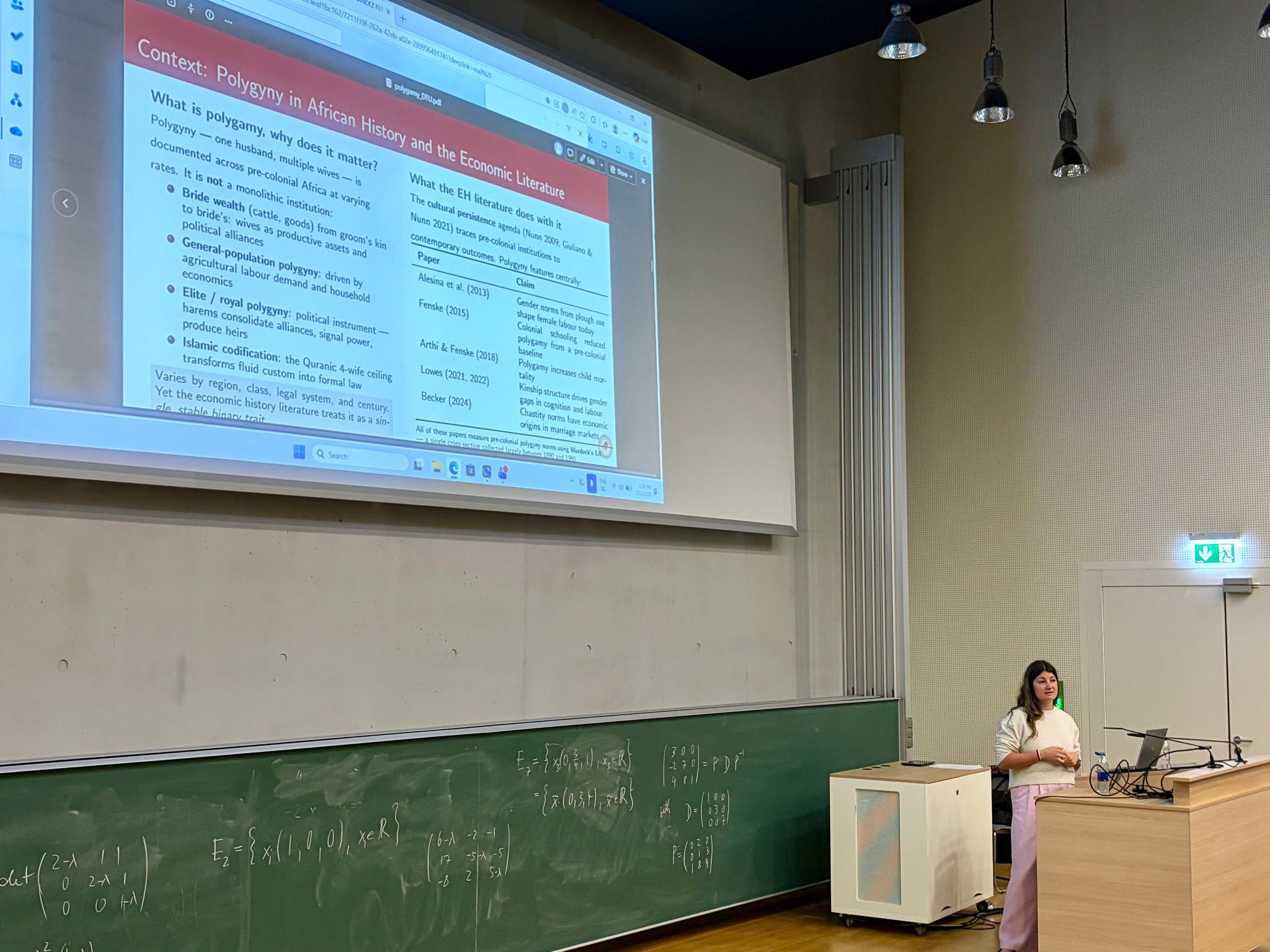
Pietro Querci and I presented Beyond Murdock: Polygyny Across Time in this spirit — using machine learning, LLMs and the Time Traveller corpus of European travel accounts to trace how marriage structures shifted across Africa between 1600 and 1900. The questions were the ones you want from a keen audience: observer bias, what gets lost in binary coding, whether the travellers themselves carry assumptions worth tracking. All easier to fix at the beginning than after a dataset has been cited a thousand times, before a dataset calcifies into infrastructure.

The workshop’s closing panel — featuring Gareth Austin, Jutta Bolt, Carl Mueller-Crepon, and Michiel de Haas — put three options on the table, ranging from incremental improvement to scrapping the unit of analysis entirely and starting from how ethnic identity actually works — constructed, contested, fluid, and time-dependent. The work presented across the day — from archival GIS reconstruction for 17th-century Angola, phylogenetic methods, to subnational survey analysis — showed that creative alternatives already exist. The problem is not imagination. It is the hard, unglamorous work of codifying things that resist codification — variables that are fluid, contested, and relational by nature, and that lose something essential every time you force them into a column.
The EHS roundtable and the LSE workshop made the same point from different vantage points. The field is changing — in what AI makes possible, in what new methods reveal about the limits of old data, in what readers and reviewers are beginning to expect. That is not a threat to historical expertise, but an invitation to rebel — as Fourie put it — to pick up the instruments now available and use them to ask better questions, build better sources, and stop accepting inadequate proxies because no alternative has the coverage or citeability to replace them yet. Building that alternative is exactly the kind of work historians are best placed to do: domain expertise, source criticism, an eye for what a dataset actually is and isn’t.
None of that happens quickly. Writing demands a patience that feels increasingly countercultural — the discipline of sitting with a half-formed thought long enough for it to become something, rather than reaching for the next thing. The ideas are there. The task now is doing them justice on the page. April reminded me that the field, at its best, is asking exactly the right questions. That’s a good place to be working from.