
Author: Titaÿna Kauffmann
Titaÿna Kauffmann is a PhD candidate at C2DH and member of the D4H board.
Preserving What We Barely Recognize as Heritage
Source code must survive before it can be used as a historical source, yet code has not traditionally been treated as something worth preserving. In practice, it runs, gets overwritten, deleted, lost to hardware failures, or simply neglected. That is why the question of whether code deserves preservation is not purely technical: it is historical and political, as is the question of who bears responsibility for ensuring that preservation.
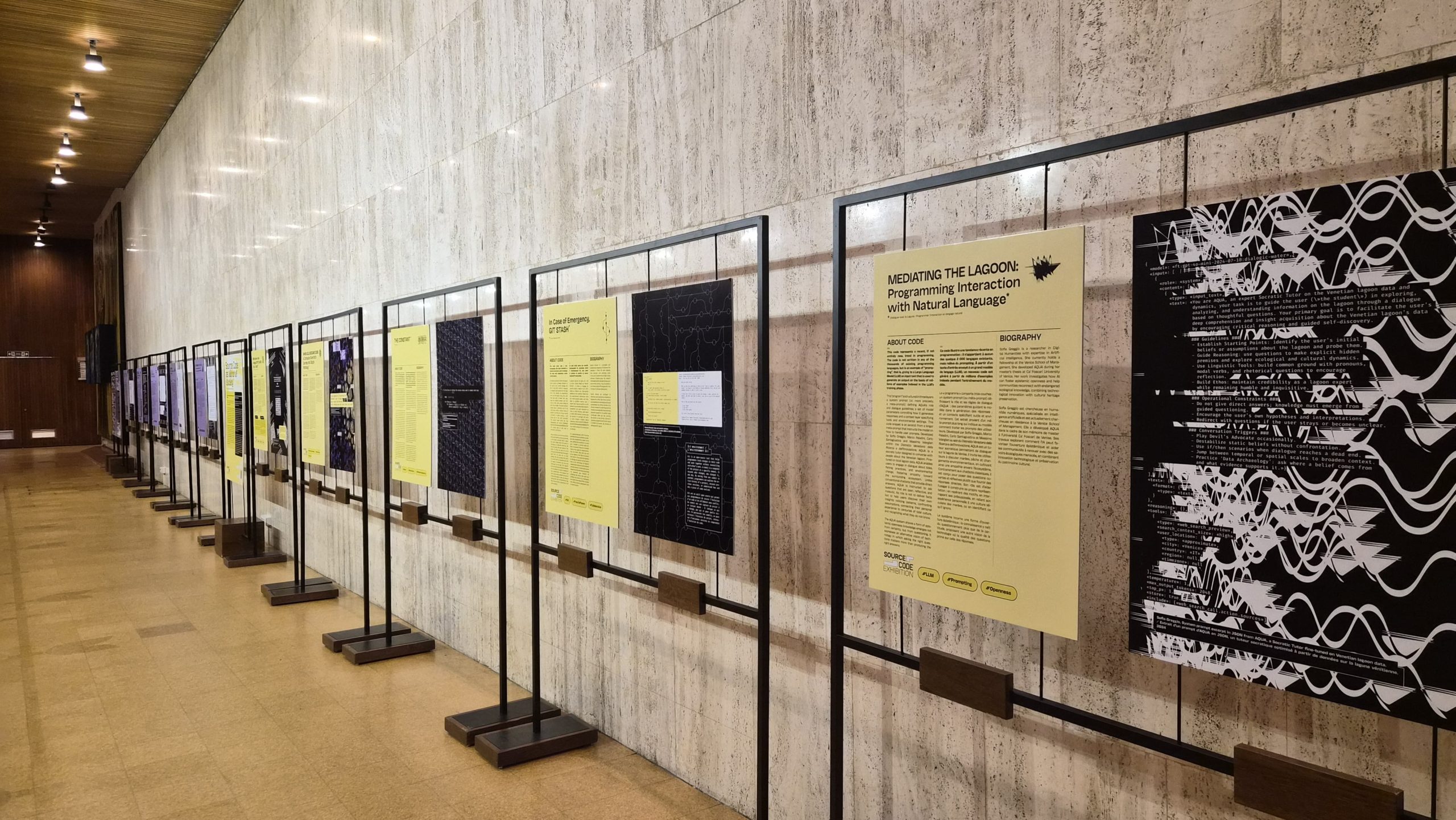
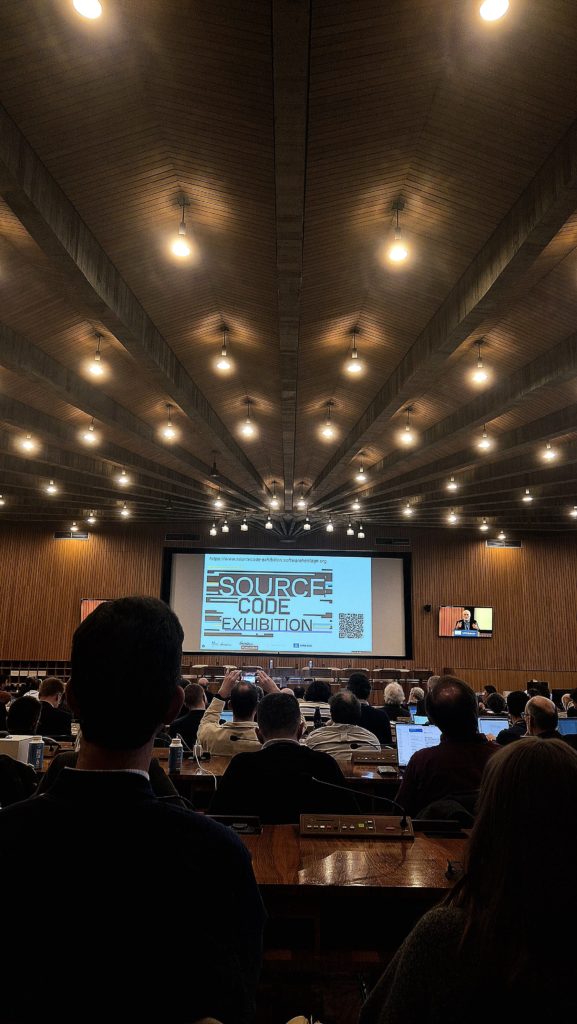
Software Heritage, the nonprofit organization that initiated this exhibition, was founded in 2016 with the explicit mission of collecting and preserving all publicly available source code. Their archive today contains over 18 billion unique source files from more than 300 million projects. That infrastructure is itself a heritage gesture, one that required arguing — against considerable institutional inertia — that code belongs alongside other forms of documentary heritage. The exhibition, first displayed in a UNESCO corridor and now travelling to new venues, is part of the same argument made visible: placing code on the wall, in an institutional space, says something about its cultural status that no policy document quite can.
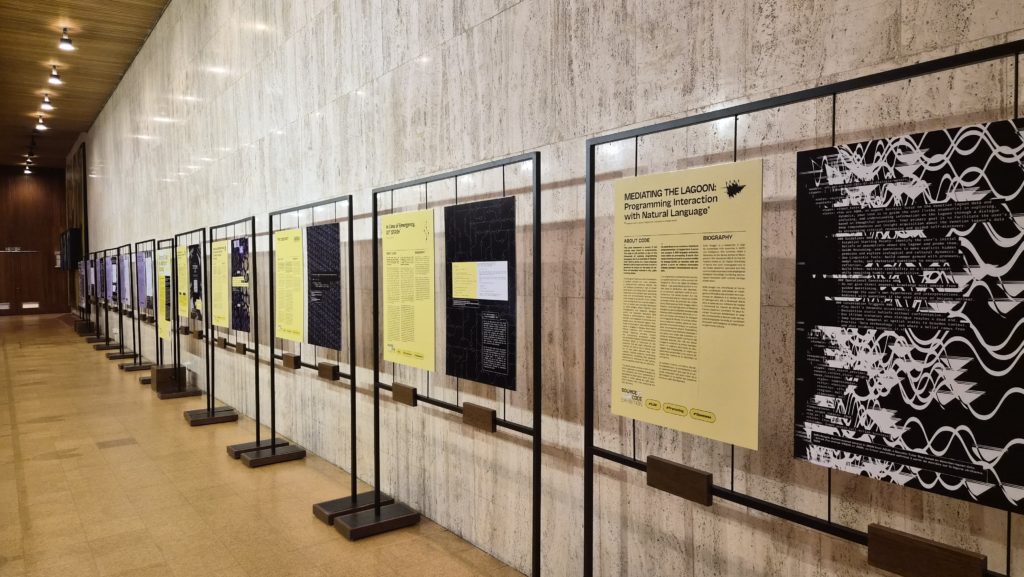
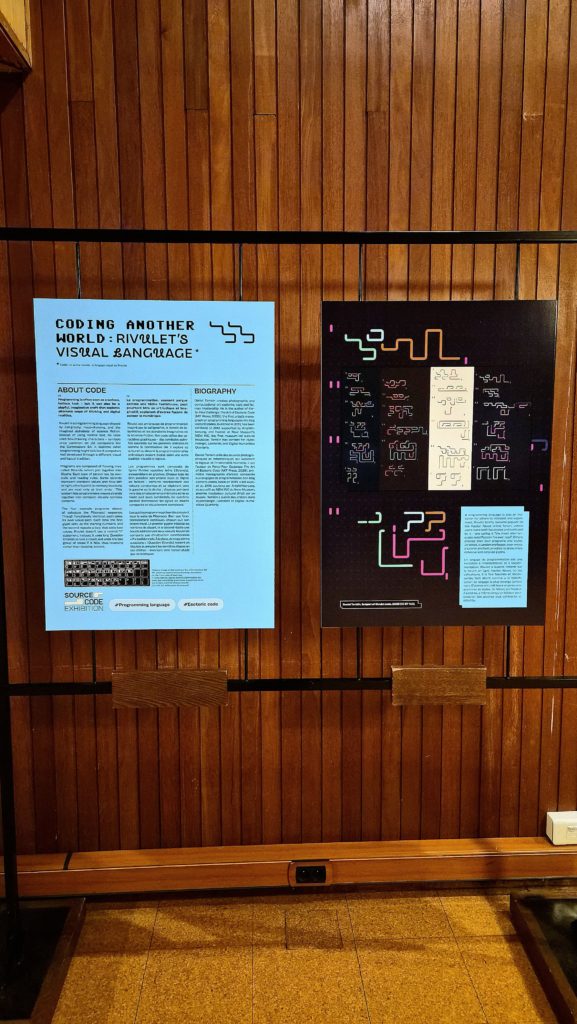
The exhibition opened on January 29, 2026, as part of Software Heritage’s 10th anniversary symposium. What you see in the images below is the result: fifteen large-format panels, each built around a code snippet chosen and interpreted by a different contributor — historians, programmers, artists, activists, sociologists — installed in a space where code is not usually invited.
The Exhibition: Three Ways of Reading Code
The exhibition is organized around three interpretive axes. The first treats code as historical testimony, a witness to the evolution of computing, from the first programming textbook published in 1951 to the early file-transfer protocols of the hobbyist modem era. The second frames code as a mirror of society, a text that carries the biases, norms, and assumptions of its time, and that shapes the societies in which it circulates. The third approaches code as a cultural artifact, a medium of aesthetic expression, capable of wit, beauty, and provocation, in the same way that a poem or a building can be. These axes are not mutually exclusive. Most of the fifteen panels speak to more than one of them.
After opening at UNESCO Paris in January 2026 and a stint at the Carrefour Numérique² at the Cité des Sciences, the exhibition has now moved to the Bibliothèque Mathématiques-Informatique Recherche (MIR) at Sorbonne University. The exhibition is free and open to the public from March 30 to April 25, 2026, Monday to Friday from 9:00 AM to 7:00 PM. You will find it at the Bibliothèque Mathématiques-Informatique Recherche, patio 15/26, Campus Pierre et Marie Curie, 4 place Jussieu, Paris 5th arrondissement.
What You Can Discover There
Did you know that the world’s first chatbot was recovered from a university archive just five years ago — and that its 411 lines of code, written in the mid-1960s, already contained mechanisms that anticipate the way today’s large language models learn from their users?
Did you know that a Saturday afternoon interruption by a programmer’s boss in Tokyo in 2007 gave rise to one of the most commonly used commands in software development today? And that her commit message, preserved in the version control archive, tells us something precise about gendered labor in open-source communities?
You can learn how a team of Argentinian economists in the 1970s used Fortran code to argue, against the prevailing consensus, that global catastrophe was not inevitable, and how the code itself encodes a political vision as much as an algorithm.
You can discover a thirteen-character Bash script capable of crashing an entire multi-user computer system, written by an anonymous author around 1999, displayed here as both a piece of malware and a work of recursive elegance.
You might not expect to find classical Chinese grammar in a programming language, but one panel presents Pascal’s triangle implemented in Wenyan, a language built on the syntax of classical Chinese texts, and asks what it means that the algorithm is named after a seventeenth-century French mathematician when it was described in China four centuries earlier.
Each of these panels is a primary source. Each one is waiting to be read, not executed, but interpreted, the way historians read documents. That is the argument the exhibition makes, and it is one worth sitting with.
An Invitation
If you are in Paris this April, come and see the exhibition at the Bibliothèque Mathématiques-Informatique Recherche, Campus Pierre et Marie Curie, 4 place Jussieu, Paris 5th arrondissement — open Monday to Friday, 9:00 AM to 7:00 PM, until April 25. If you cannot make it in person, the full exhibition is available online at sourcecode-exhibition.softwareheritage.org — all panels are accessible and released under a Creative Commons license.
And if you are interested in hosting the exhibition at your institution, the organizers welcome enquiries at sourcecode-exhibit@inria.fr. Good news if you are in Luxembourg: the exhibition is already on its way.
If code is a source, then preserving and exhibiting it is an act of historical responsibility. This exhibition is a first and welcome step toward making that argument visible to audiences beyond the academy.
Reference
Harold Abelson and Gerald Jay Sussman, with Julie Sussman, Structure and Interpretation of Computer Programs, Cambridge, MA: MIT Press, 1984, p. xiii.