

Andreas shares some of his notes on the “Archives as data” conference at Columbia University and an AHA panel on “Large Scale Research Infrastructures in History”

Author: Andreas Fickers
Andreas is the director of C2DH and of our Deep Data Science for Digital History doctoral training unit.
What are the challenges of born-digital data for historical research and archival sciences? How to deal with digital memory technologies like SIM cards as material evidence of the digital age? How to decolonize archival meta-data and descriptions when translating analogue collections into digital repositories? Such were the questions discussed at a one-day conference jointly organized by Columbia’s History Lab (lead by Matt Connelly) and the Columbia Libraries on January 3rd this year and funded by the National Endowment for the Humanities “Archives as Data” program. The conference program offered a great variety of topics and approaches, ranging from questions of data ethics and access to challenges of handling large scale datasets and algorithmic biases in search and visualization tools. A common concern discussed was how to deal with “going beyond” textual data by developing multi-modal approaches to distant viewing, reading, or listening in a scalable fashion. A particularly promising project called “Democracy Viewer” was presented by Steph Buongiorno, Postdoctoral Research Fellow at the Southern Methodist University. The project, which is sponsored by Jo Guldi from Emory University, aims at offering a free platform for text-based data analytics and data sharing across the humanities and social sciences, based on a simple interface allowing for the upload of datasets or the connection to APIs. While in a prototype status right now, Democracy Viewer has a great democratizing potential by making the upload, search, and visualization of research data easy and accessible for everyone.1
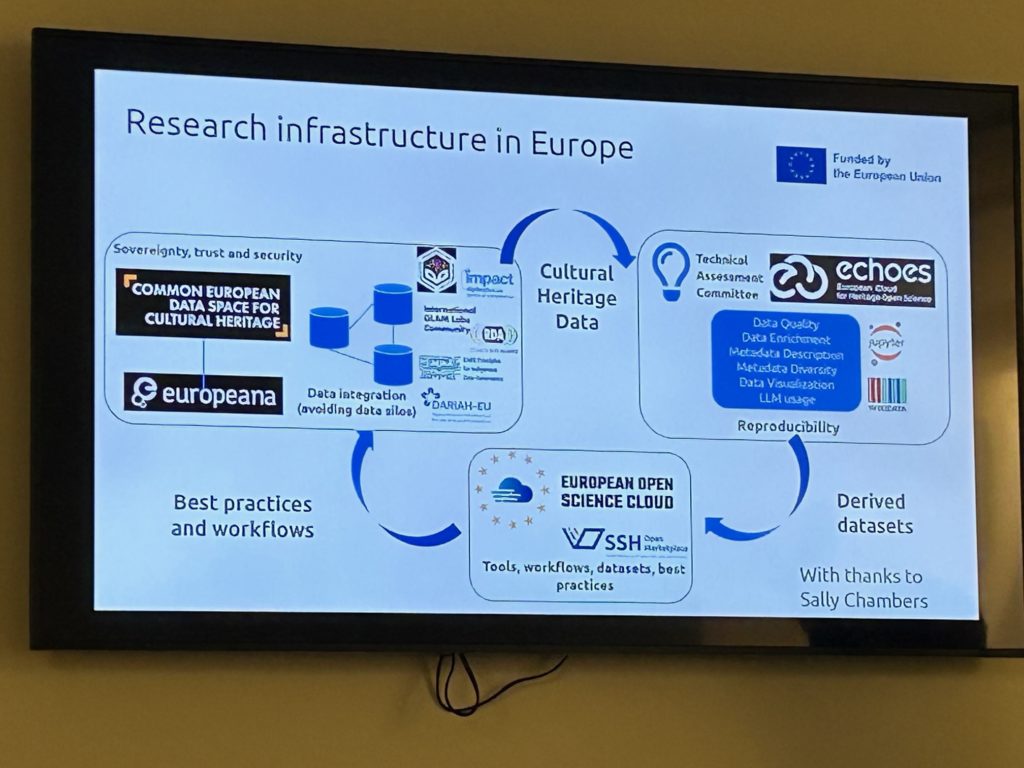
My stay in New York also allowed me to participate at the American Historical Association annual conference where I was part of a panel on Large Scale Research in Digital History. The panel was put together by Prof. Will Thomas, Dean of College of Lettes and Science at Montana State University, Vice President of AHA Research Division, and founding member of the Scientific Committee of the C2DH. The panelists, including Jo Guldi, Matthew Connelly, Daryle Williams, and myself, explored the possibilities and challenges of large-scale historical research in the discipline of history. For decades historians have been at the forefront of collaborative, computational, and digital research, but the scale, volume, and complexity of historical records have expanded far beyond the capacity of individual scholars and require collaborative approaches and shared infrastructures. Historians are increasingly engaged with questions of data sovereignty, access, and preservation. One issue of debate was the fact that despite the significance of these historical records, federal and private foundation funding for historical research, often tailored for individual researchers, has remained largely static. To my surprise, the C2DH and European initiatives such as DARIAH are seen as “models” for future developments in the United States. The fact that cutting edge digital history research is “infrastructuring work” has clear implications when it comes to questions of sustainable funding and the institutionalization of collaborative research at large scale. To learn that C2DH is “ten years ahead” and that large PhD programs like the Doctoral Training Unit “Deep Data Science of Digital History” (D4H) are rare in the US context was definitely flattering and a pleasant surprise to me (😊), but it also reinforces our institutional responsibility to act as hub for the sharing of knowledge in the spirit of open science.
1) For more information on the project see the GitHub repository; https://github.com/stephbuon/democracy-viewer/tree/main